
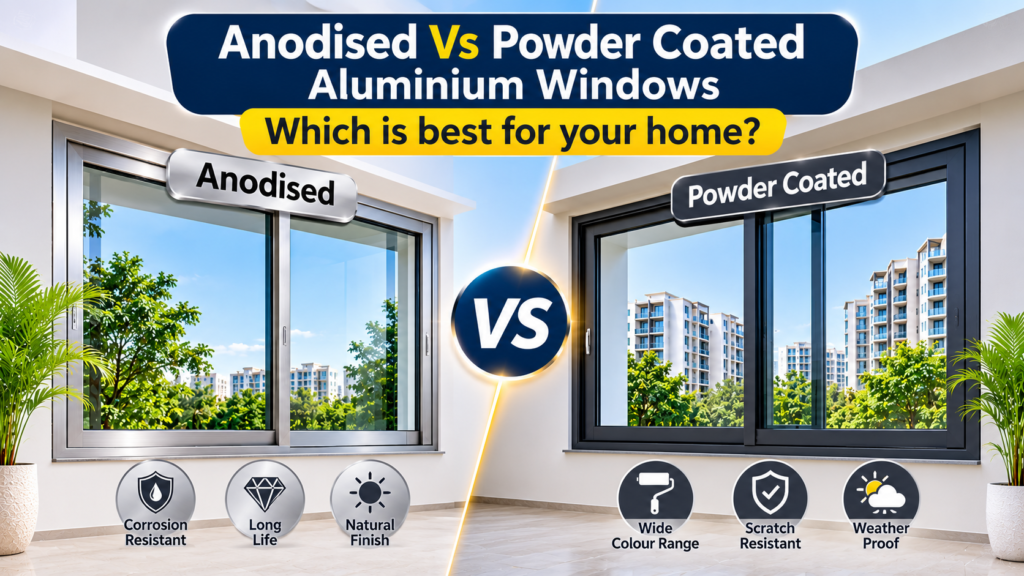
You’ve chosen aluminium windows for your home. Then comes a question that confuses many buyers: should the finish be anodised or powder coated? Both protect the metal and both look good, but they work differently and suit different needs.
What Is Anodised Aluminium?
Anodising is an electrochemical process. The aluminium is placed in a special bath and an electric current forms a hard oxide layer on the surface. Because the layer grows from the metal itself, it does not peel or chip the way paint can. The result is a natural metallic look. In India, anodic coatings on architectural aluminium are covered by the standard IS 1868.
What Is Powder Coated Aluminium?
In powder coating, a dry coloured powder is sprayed onto the frame and then baked so it melts into a smooth, even layer. Powder coating offers a broad colour range, including wood-look finishes, and most coloured aluminium windows follow the Qualicoat standard.
Anodised vs Powder Coated: Key Differences
1. Durability
Anodising is generally seen as the more durable option. One industry guide estimates anodised finishes last 40+ years versus 15–25 years for powder coating. Real life depends on quality, thickness and maintenance, so treat these as indicative figures. Powder coating is still durable. A university study on cladding notes that powder coating replaced anodising in Norwegian window cladding to improve weather and corrosion resistance, so quality powder coating performs well too.
2. Colour and Appearance
If you want bold colours such as black, bronze, white or wood grain, powder coating gives more choice. Anodising gives a refined metallic look in limited shades. Colour consistency can also vary between anodised batches.
3. Cost
Powder coating is usually cheaper, while anodising costs more because the process is more demanding.
4. Repair
Anodised surfaces are hard to repair. A scratch during manufacturing or installation can mean replacing the section. Powder coating is easier to touch up, which is why some homeowners choose it to avoid the risk of damage during construction.
5. Maintenance
Both are low-maintenance. Wash with mild soap and water every few months and avoid abrasive cleaners.
Which One Should You Choose?
| If you want… | Choose |
|---|---|
| Maximum long-term durability and a natural metal look | Anodised |
| A wide colour palette and design flexibility | Powder coated |
| A lower upfront cost | Powder coated |
| Easier touch-ups on site | Powder coated |
Pune’s moderate climate and monsoon suit either finish, provided it is applied to good standards. Rather than asking which finish is better in general, ask which finish is better for your colours, budget and timeline.
What to Ask Your Supplier
- Is the finish anodised or powder coated, and to which standard?
- What is the coating thickness, and is the warranty in writing?
- Is the coating done in a factory under controlled conditions?
- What is the policy if a frame is scratched during installation?
Tostem Windows and Doors
Tostem, a Japanese brand under LIXIL, uses a proprietary finish called TEXGUARD. Brand materials describe it as an anodised finish that protects against heat, light and water, and state that colour and gloss are retained for up to 40 years. Another description says it combines an anodic layer with an organic top layer. Tostem’s own material also argues that anodising gives a uniform thickness of around 20 microns, while powder coating thickness typically varies between 60 and 120 microns. These are manufacturer claims, so ask to see the warranty terms.
Tostem windows are pre-engineered, meaning the components are made in a factory rather than fabricated on site. LIXIL has also announced a new Hyderabad plant to deliver Tostem quality made in India. If you want an anodised-type finish and system-window precision, Tostem windows and doors are worth comparing against powder-coated options.
Choose anodised if you value long-term durability and a natural metallic look and can budget for it. Choose powder coated if you want more colours, easier repairs and a lower cost. Whichever you pick, quality of application and installation matter as much as the finish type.